


Incubation management software that runs the whole program
EcoSync is incubation management software for incubators, accelerators and technology business incubators. One white-labelled portal for applications, weighted panel evaluation, office space, facilities, funding and reporting - with an audit trail on every decision.
The problem is not the program. It is the tooling around it.
Most incubation teams do genuinely good program work on top of tooling that fights them. Applications arrive through a form builder. Evaluation happens on a shared spreadsheet. Documents are chased over email. Grant tranches are reconciled by hand at the end of the quarter, from three different places.
That holds together at twenty applications. At eighty applications with five panel members, twelve outstanding documents and a government grant split across three tranches, it stops holding together - and the time goes into administration instead of the founders.
Incubation management software is not a form builder with better styling. The difference is whether the system can hold a weighted rubric across multiple evaluators, keep a status on every document you have asked for, and tell you where a specific rupee went eight months later.
- A form cannot give you comparable scores across five evaluators and two cohorts
- A spreadsheet cannot tell you who changed an application's status, or when
- An email thread is not a document-request workflow with a state
- A folder of receipts is not funding traceability
Programs, end to end
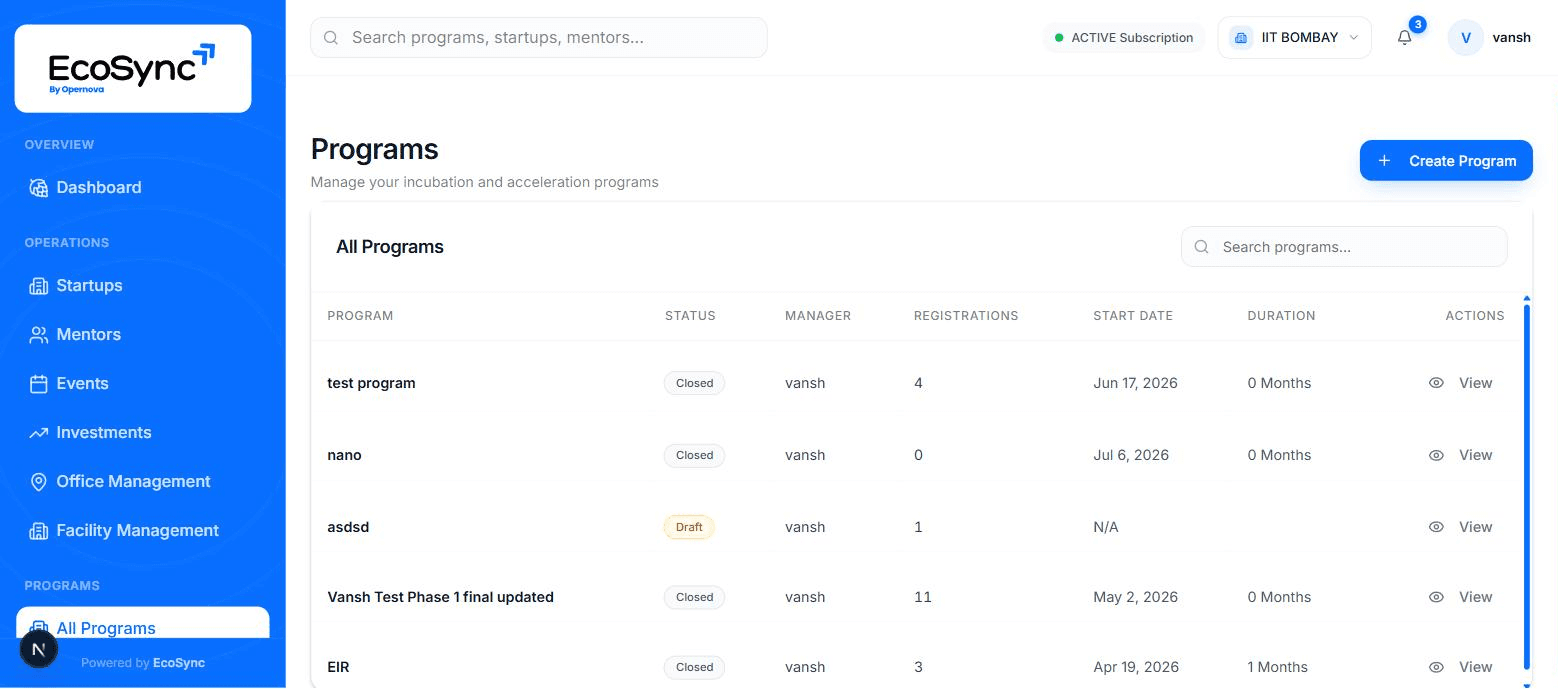
Build a program, define its application form, open a batch, and take applications through to onboarding without leaving the portal.
Application forms are built from eight question types with a reusable question bank, so the fourth program you launch does not mean rebuilding the same twenty questions. Batches sit inside a program, which means Batch 1 and Batch 5 can run side by side without duplicating the program itself.
Custom application forms
Eight question types and a reusable question bank. Ask exactly what your program needs, and stop rebuilding the same form every cohort.
Batches inside a program
Run concurrent cohorts under one program definition, with bulk startup registration where you already know who is coming in - or import them, history and all, from the spreadsheet you already keep.
Six application phases
A real pipeline rather than a spreadsheet column, with a full audit trail recording who moved an application and when - and what the startup still owes shown beside it.
Change and document requests
Ask an applicant for a missing document from inside the system and track its state. The chase stops living in your inbox.
Evaluation you can defend to a committee
Panel evaluation is where spreadsheets do the most damage, because the damage is invisible. Two evaluators scoring out of ten with no shared rubric produce numbers that look comparable and are not.
In EcoSync you define a rubric of weighted questions with scored options. Panel members are assigned to specific programs and can only evaluate applications inside those programs. Each evaluator scores independently, and the system aggregates a per-evaluator breakdown, per-question averages and a total weighted score.
External experts can be added as panel members without being granted a full portal role - so you can bring a domain specialist in for one program without giving them access to everything else.
Money you can trace
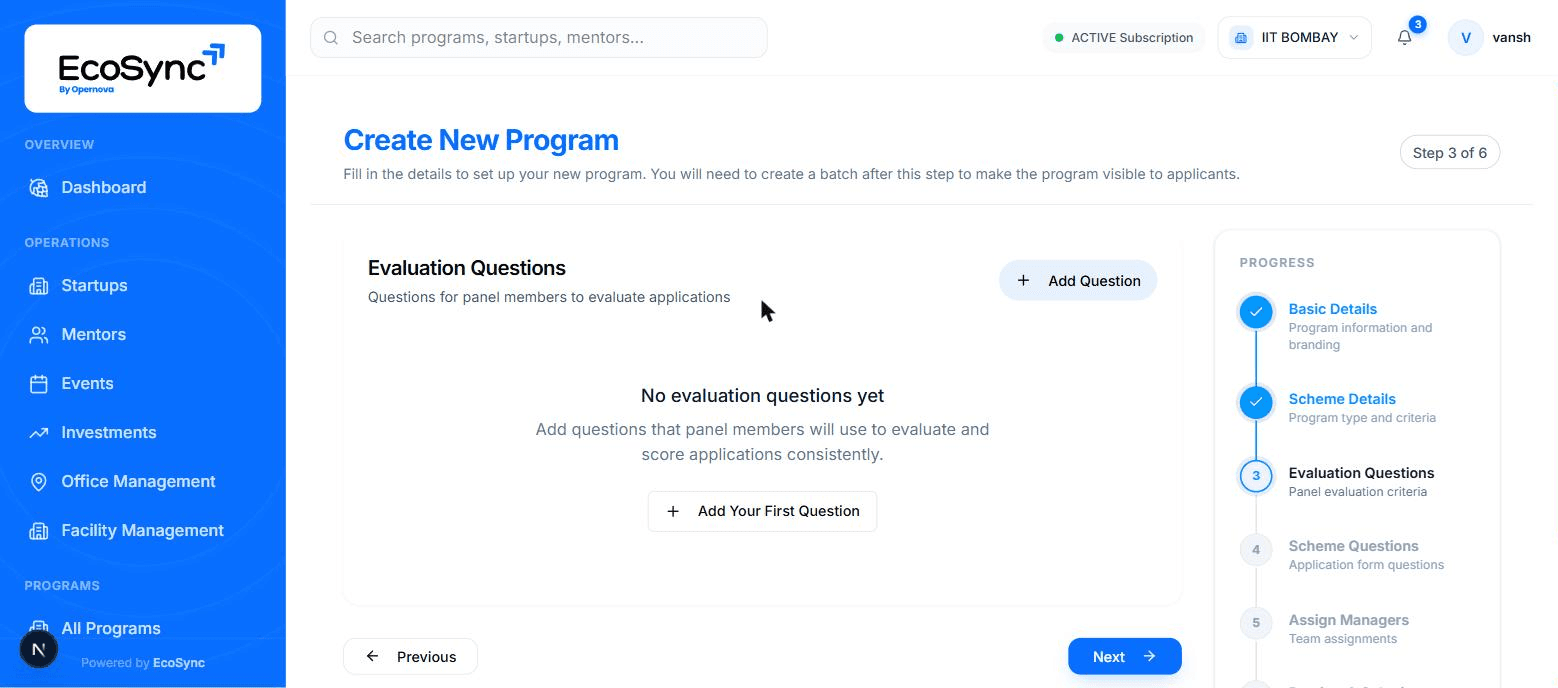
Funding moves through three stages that most incubators track in three unrelated files: the source it came from, the program it was allocated to, and the tranche that actually reached a startup.
EcoSync models all three as one chain. Over-allocating a source is blocked rather than discovered later. Startups can raise funding requests themselves, and an approving officer can override the requested amount with an approved amount, so the request, the decision and the disbursement are all one traceable record.
This is the part that matters when a grant funder or a university committee asks a question about a disbursement from two years ago.
Space, facilities and the operational work
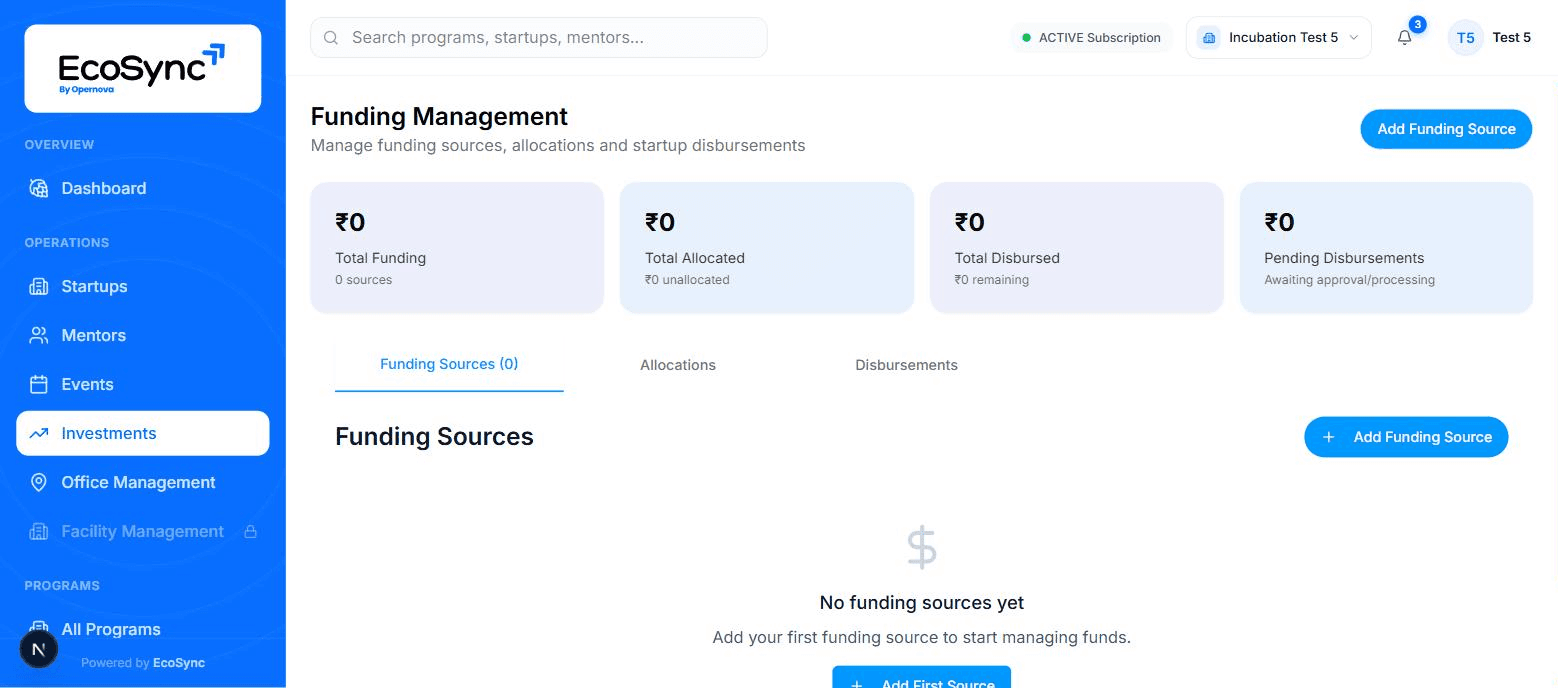
Desks, labs and meeting rooms are a real part of running an incubator and are usually managed on a whiteboard.
Office space supports five pricing tiers, deposits and recurring rent subscriptions, with payouts landing in your own account after verification. Facilities are bookable against day-of-week time slots with an approval step. Task boards cover both your incubation team and each startup. Announcements can be targeted at one program, one startup or one role, with read tracking so you know whether they landed.
Office space with real commercial terms
Five pricing tiers, deposits and recurring rent. Desks become a managed revenue line instead of a spreadsheet.
Facility booking with approvals
Labs and meeting rooms get day-of-week time slots and an approval workflow, so booking stops being a WhatsApp negotiation.
Task boards
Separate boards for the incubation team and for each startup, so cohort deliverables are tracked rather than remembered.
Targeted announcements
Reach exactly one program, startup or role, delivered in-portal and by email, with read tracking.
Your own workspace, isolated and branded
You sign in at ecosync.co and land in your incubator's own workspace, carrying your logo and your brand colours. Nothing to install, nothing to host, no separate deployment to maintain - and if your team works with more than one incubator, they switch between workspaces without signing out.
Each incubator's data is fully isolated. One incubator cannot see another's applications, startups or funding. Data is encrypted in transit and at rest, access is controlled by a five-level permission model with per-user overrides, and every permission denial is logged alongside every status change - which is what makes the audit trail usable for grant and compliance reporting rather than merely present.
- Your own branded workspace - your logo, your colours
- Complete data isolation between incubators
- Encrypted in transit and at rest
- Five-level permissions with per-user overrides
- Audit trails on applications, tasks, funding and announcements
Optionally connected to EcoSync Network
EcoSync Network is a separate product - a public network at ecosync.network where founders, mentors, investors and talent connect with each other. It is not part of your incubation workspace, and you do not need it to use EcoSync.
If you choose to connect the two, they share one identity layer. A startup that applies to your program is already a profile on the network. A mentor you onboard comes with existing reviews and availability. Your open programs become discoverable to founders, so you spend less time chasing applicants.
Your workspace works exactly as well without it. The connection is opt-in.
A cohort, from the call opening to the money landing
Most incubation software describes features. This is the sequence they actually run in, because that is what tells you whether a tool fits the way your programme already works.
You build the programme and its batches, then the application form from eight question types - multiple choice, short text, long text, file upload, date, number, checkbox and dropdown - reusing questions you have asked before rather than rewriting them each intake.
Applications arrive and move through six phases - new, reviewed, under evaluation, evaluated, verified and onboarded - or are rejected at any point. Every move records who made it and when. Requests for changes and documents sit beside the phase rather than replacing it, and they earn their keep quietly: 'waiting on them' and 'waiting on us' stop looking the same in a list, and an application can be under evaluation while it still owes a certificate.
Evaluation runs against the rubric you defined while building the programme. Panel members - including external experts who never receive a full portal login - score independently, and you keep the per-evaluator breakdown rather than an average that hides where they disagreed.
Onboarded startups get desks or offices with pricing, receipts and payouts, and facilities they can book by the hour. Funding is released from its source, through the programme allocation, to a specific tranche for a specific startup.
Start from the spreadsheet you already keep
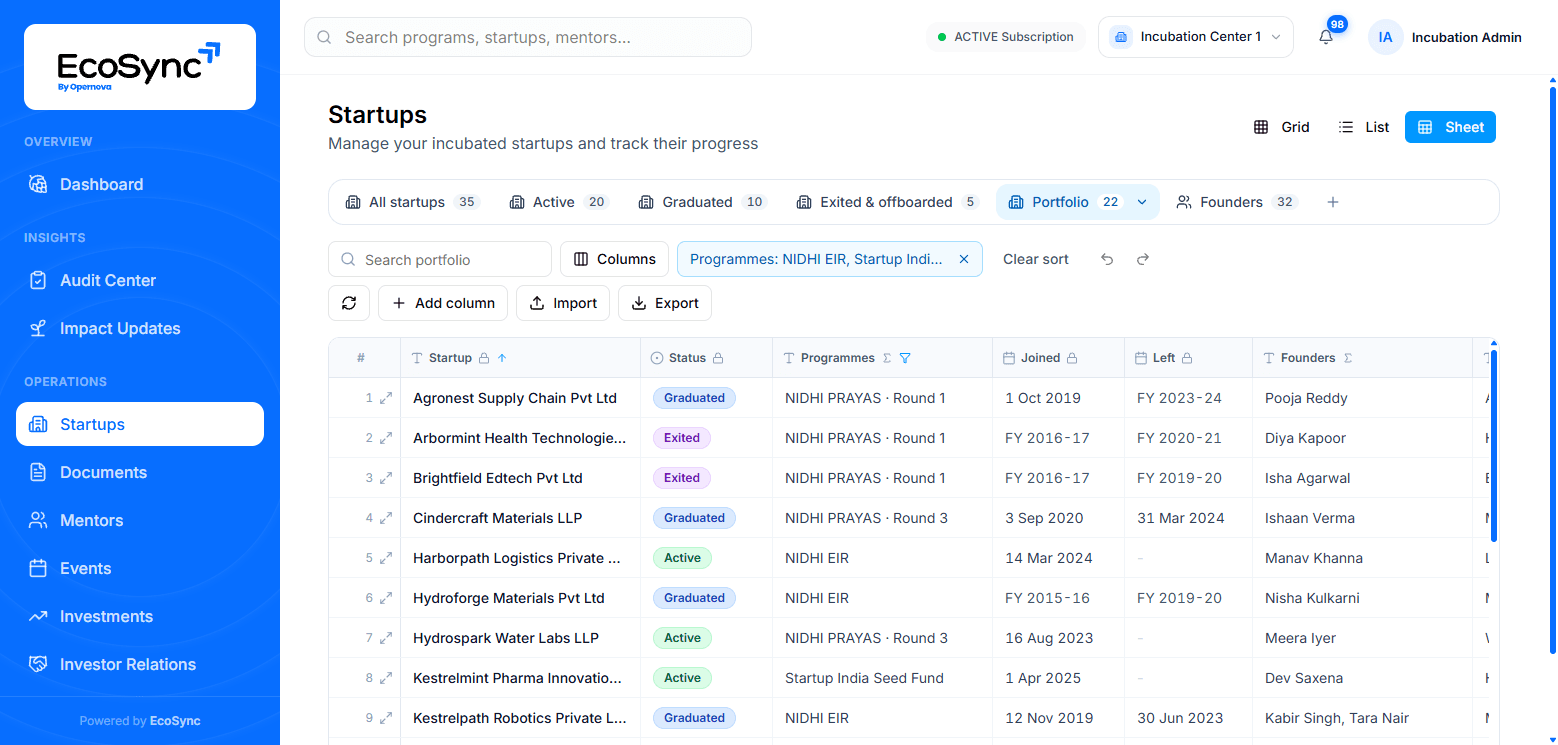
Most incubators arrive with years of startups in an Excel file: one row per company, a column per scheme, dates typed however the person that year typed them. Moving to software should not mean retyping it, and it should not mean losing the spreadsheet's good parts either.
Import the file as it is. The header row is found, each column is matched to the field it means and shown to you before anything is written, schemes become programmes and batches, and a company's founders are split out of a single cell. Dates keep the precision the file had - a bare year stays a year - and rows that cannot go in are listed with the reason, to fix or leave out. Nothing is saved until you commit, and an import can be undone for 15 minutes after it finishes, as long as nobody has started working on what it made.
After that the portfolio can be worked on as a sheet: tabs you save, columns of your own, paste from Excel, and a history on every cell. Status and dates still change through the lifecycle, with the date it happened, so the sheet cannot quietly rewrite a startup's past.
Import your startup list
Excel or CSV, messy headers included. Every column's meaning is shown before anything is written, and a row that matches a startup already on EcoSync can be linked to it rather than duplicated.
A sheet with a memory
Saved tabs, your own typed columns and internal notes, with who changed each cell and when. A colleague's edit to the same cell is shown to you rather than silently overwritten.
Excel out, and back in
Export the tabs you choose to one workbook, in your column order and under your headers. Edit it and upload it back, and each row returns to its record.
Founders keep what is theirs
A startup's own details stay the founder's. Your changes to them go as suggestions they apply or dismiss, and founders of startups still with you can be invited to claim the record you kept.
What a funder asks for, and where the answer comes from
The questions that arrive months after a cohort closes are always the same three, and they are the ones a spreadsheet answers worst.
“How was this cohort selected?” The weighted rubric, the per-evaluator scores and the full status history are all still there, so the answer is a record rather than a recollection.
“Where did the grant go?” Funding is traceable from the source it came from, to the programme it was allocated to, to the tranche that reached a named startup. Over-allocation is blocked where the commitment is made, so a programme cannot promise the same rupee twice and reconcile it afterwards.
“Who could see what?” Permissions are set per module and per role with per-user overrides, and denials are logged. An external evaluator's reach stops at the programmes they were assigned to.
Where a funder or a state portal wants the data rather than a report, a chosen repository can be exposed through the public data API - an API key, rate limiting, and an access log for every request.
- Eight question types, and a question bank reused across intakes
- Six application phases, each move stamped with the person and the time
- Per-evaluator scoring retained, not averaged away
- Funding traced source → allocation → tranche, with over-allocation blocked
- A public data API with keys, rate limiting and access logs
Questions people actually ask
What does incubation management software actually do?
It replaces the stack most incubators assemble from forms, spreadsheets and email. In one system: build programs and application forms, run applications through a status pipeline with an audit trail, score them against a weighted rubric across multiple panel members, request documents and changes with tracked states, manage office space and facility bookings with payments, trace funding from source through allocation to disbursement, run task boards, and send targeted announcements with read tracking.
We already use Google Forms and spreadsheets. What do we actually gain?
Four things forms and sheets structurally cannot do. A weighted evaluation rubric that produces comparable scores across several evaluators and several cohorts. A document-request loop that carries a status, so you know what is outstanding without reading your sent folder. An audit trail on every status change, with who and when. And funding traceability from grant source to program allocation to the tranche that reached a specific startup. You do not give up the sheet to get them: the list you keep today can be imported with its dates, worked on as a sheet with a history on every cell, and exported back to Excel whenever someone asks for one.
Can the portal be white-labelled with our own branding?
Yes. Your workspace carries your logo and your brand colours, so your team and your startups see your brand throughout. There is nothing to install or host - you sign in at ecosync.co and your workspace is already yours.
Is our cohort data isolated from other incubators?
Yes. Every incubator is a separate tenant and every query is scoped to that tenant, so one incubator cannot see another's data. Data is encrypted in transit and at rest, and access within your own portal is governed by a five-level permission model with per-user overrides.
How does panel evaluation work?
You define a rubric of weighted questions, each with scored options. Panel members are assigned to specific programs and can only evaluate applications within them. Evaluators score independently, and the system aggregates per-evaluator breakdowns, per-question averages and a total weighted score. External experts can be added as panel members without receiving a full portal role.
How much does it cost?
Plans are structured around user limits, startup limits, storage and which modules you get, with monthly, yearly and weekly options, plus pilot runs with a defined start and end date. Current pricing is shown inside the portal after you sign in, because plans are configured per deployment. Talk to us and we will walk you through the structure and what fits your programs.
Can one person work across more than one incubator?
Yes, with a different role at each, while remaining a single identity on the ecosystem side.
Related
- Panel evaluation software
- Funding management
- Application management
- For incubators in India
- Documentation: incubation portal overview
- Documentation: creating a program
Guides on this topic
- Writing an Incubator Annual Report People Read
Who the report is really for, the numbers that belong in it, and how to write one that helps renewal rather than just recording the year.
- Running More Than One Programme at Once
Separate cohorts, shared machinery. What has to differ between programmes, what must not, and the point at which a second one needs a second manager.
- Cohort Communication That Actually Gets Read
Why the weekly all-cohort email stops working by week four, and what to send instead so founders do not miss the things that matter to them.
- Incubator or Accelerator: The Operating Differences
Not the textbook definitions. What actually differs in selection, cadence, funding, space and staffing - and which one your organisation can staff.
- Corporate Partnerships That Outlast One Champion
Sponsored cohorts and corporate challenges pay well and end abruptly. What to agree up front, and how to keep the relationship when your contact leaves.
- Measuring Incubator Impact Without Fooling Yourself
The attribution problem nobody solves: did the programme cause the outcome, or select companies that would have got there anyway?
See the evaluation and funding flows
Twenty minutes is enough to show you how a weighted rubric works across a real panel, and how funding is traced from a grant source to a specific startup. Bring a program you are actually running.
Book a walkthroughReady to Join
the Ecosystem?
Book a demo

Explore the platform
EcoSync is a product of Opernova Technologies LLP, which also builds EcoSync Network.
© 2026 Opernova Technologies LLP. All rights reserved.