


Software for government-affiliated incubators
If you deliver a government scheme, the record matters as much as the outcome. EcoSync gives you traceable disbursement from scheme funds to startups, defensible panel selection, permission-controlled access, and a data API for publishing to a funder's dashboard.
Delivering a scheme is a different job from running a program
When funding originates from a central or state scheme, the incubator is not only supporting startups - it is accounting for public money.
That changes what the tooling has to do. Every disbursement needs to be attributable to a scheme and a sanctioned amount. Selection needs to be explainable to someone who was not present and may be reviewing it years later. Access needs to be restricted by role, and refusals need to be recorded, not just enforced. And the reporting is usually somebody else's format, on somebody else's schedule.
Most incubation tools treat all of this as an export problem. It is a record-keeping problem, and exports cannot fix a record that was never kept.
Once the record is kept, the export is the easy part. Choose the tabs a report needs and each becomes a sheet in one Excel workbook, with its columns in your order and under your headers. Exports that include founders' emails and phone numbers need their own permission, and every export is logged.
Funds traced from sanction to startup
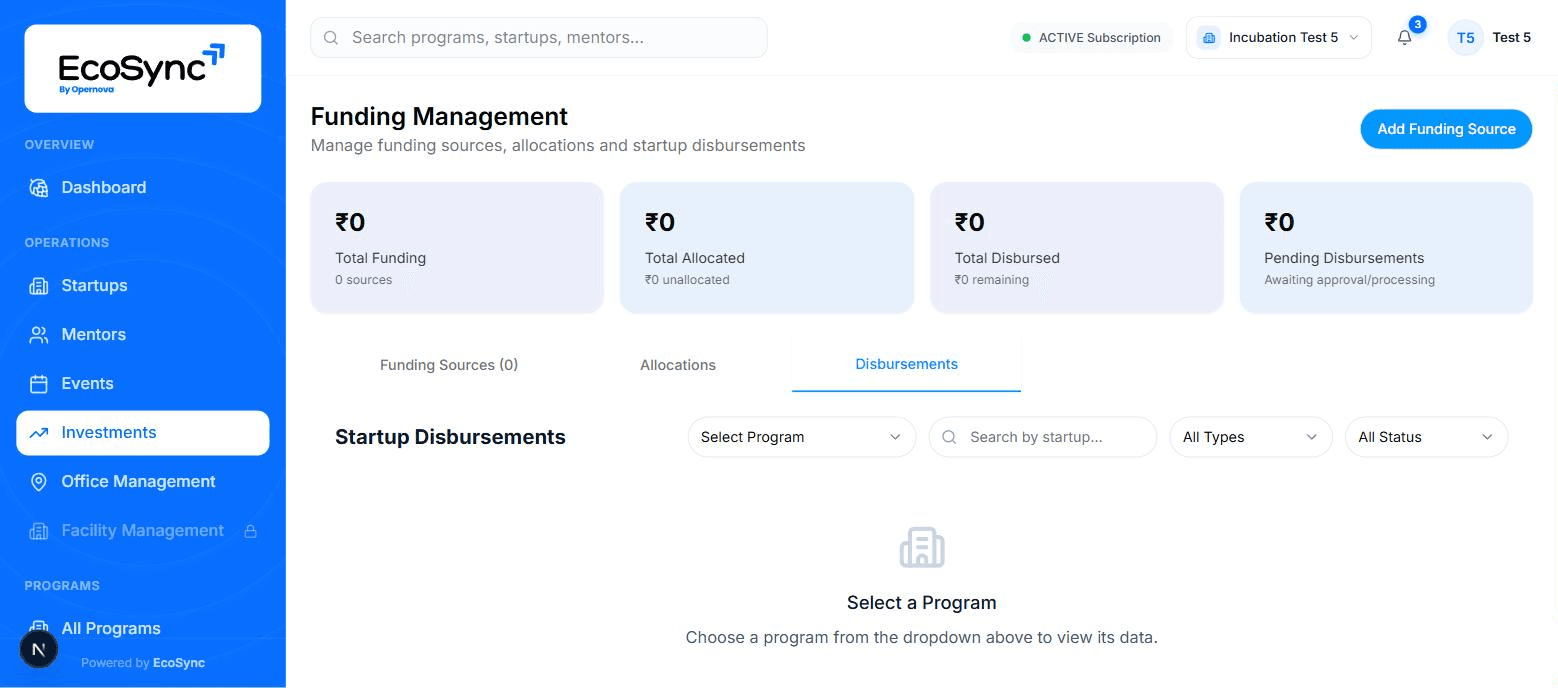
Funding is modelled in three linked stages: the source it was sanctioned from, the allocation from that source to a specific program, and each tranche disbursed to a specific startup.
Allocating more than a source holds is blocked at the point of entry rather than surfacing during an audit. Startups raise funding requests with a visible status, and an approving officer records an approved amount that may differ from the requested amount - as a proper field, not a comment. Each tranche carries its own disbursement status, so sanctioned, committed and disbursed are never accidentally the same figure.
GST and TDS are computed per transaction, so what you report matches what moved.
Selection that withstands review
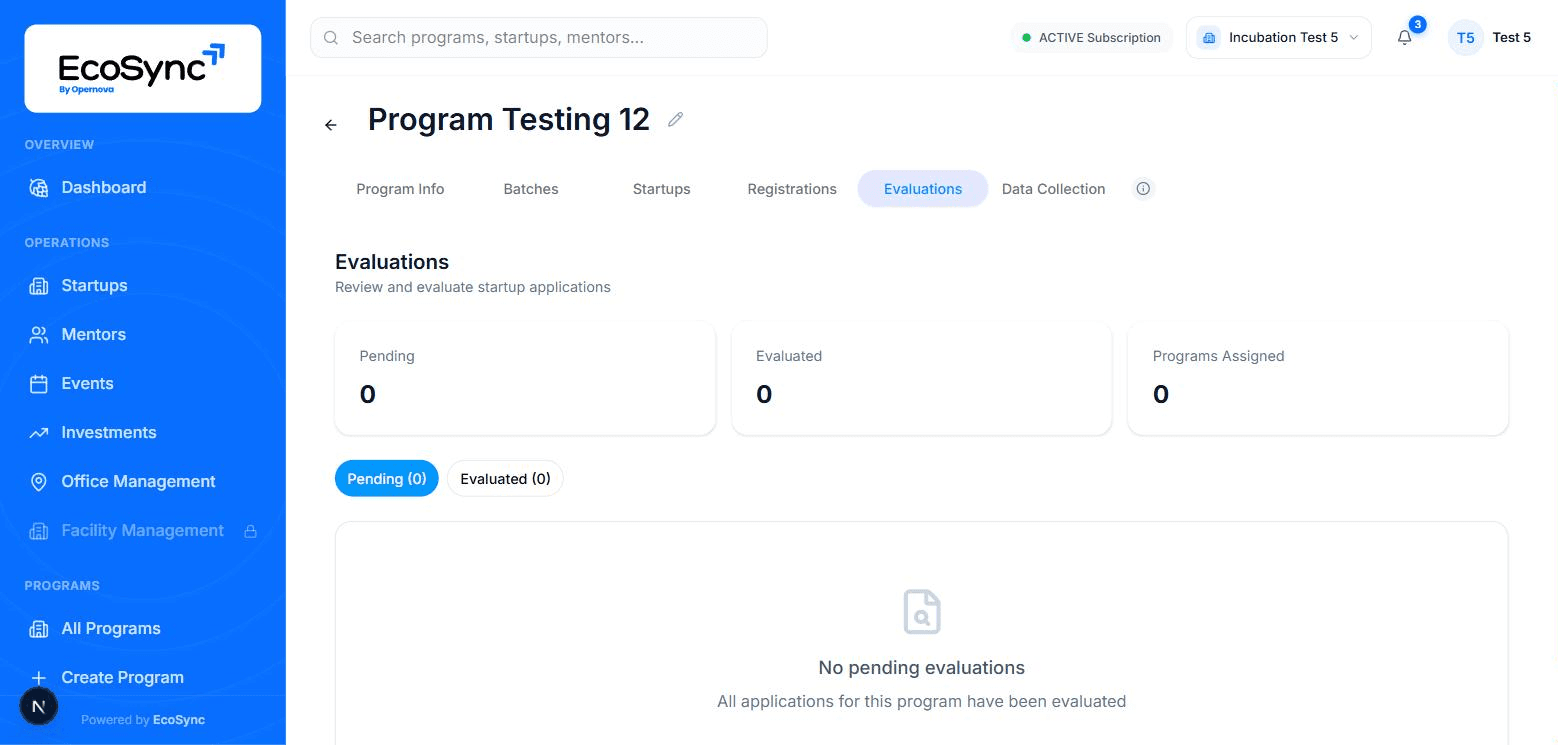
A weighted rubric with scored options, defined before applications open, produces a number that can be explained. Multiple evaluators score independently, and the per-evaluator breakdown is retained rather than averaged away - so the level of agreement is part of the record.
External subject-matter experts and empanelled evaluators can be added as panel members scoped to specific programs, without receiving a full portal role. Every application status change is logged with the person and the timestamp, and change and document requests each carry their own state.
Access control, and the record of refusals
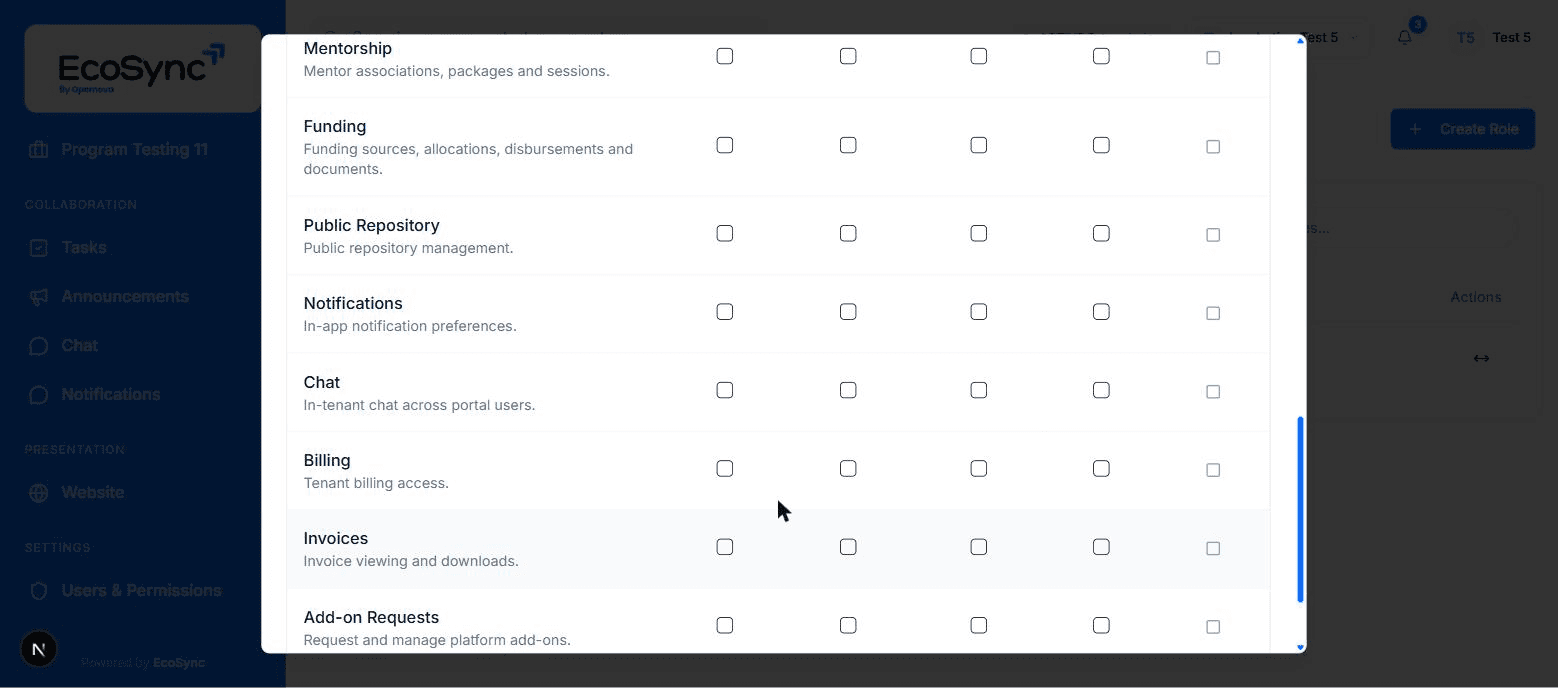
Roles are defined with a five-level permission model - create, read, update, delete, full - applied per module, with per-user overrides on top. A finance officer can work on disbursement without touching evaluation. A junior officer can process applications without approval authority.
Every permission denial is logged. That is a small detail with disproportionate value during an audit: it demonstrates that access controls were not merely configured but actively enforced.
Data is encrypted in transit and at rest, and your portal's data is fully isolated from every other incubator on the platform.
Publishing to funders and to the public
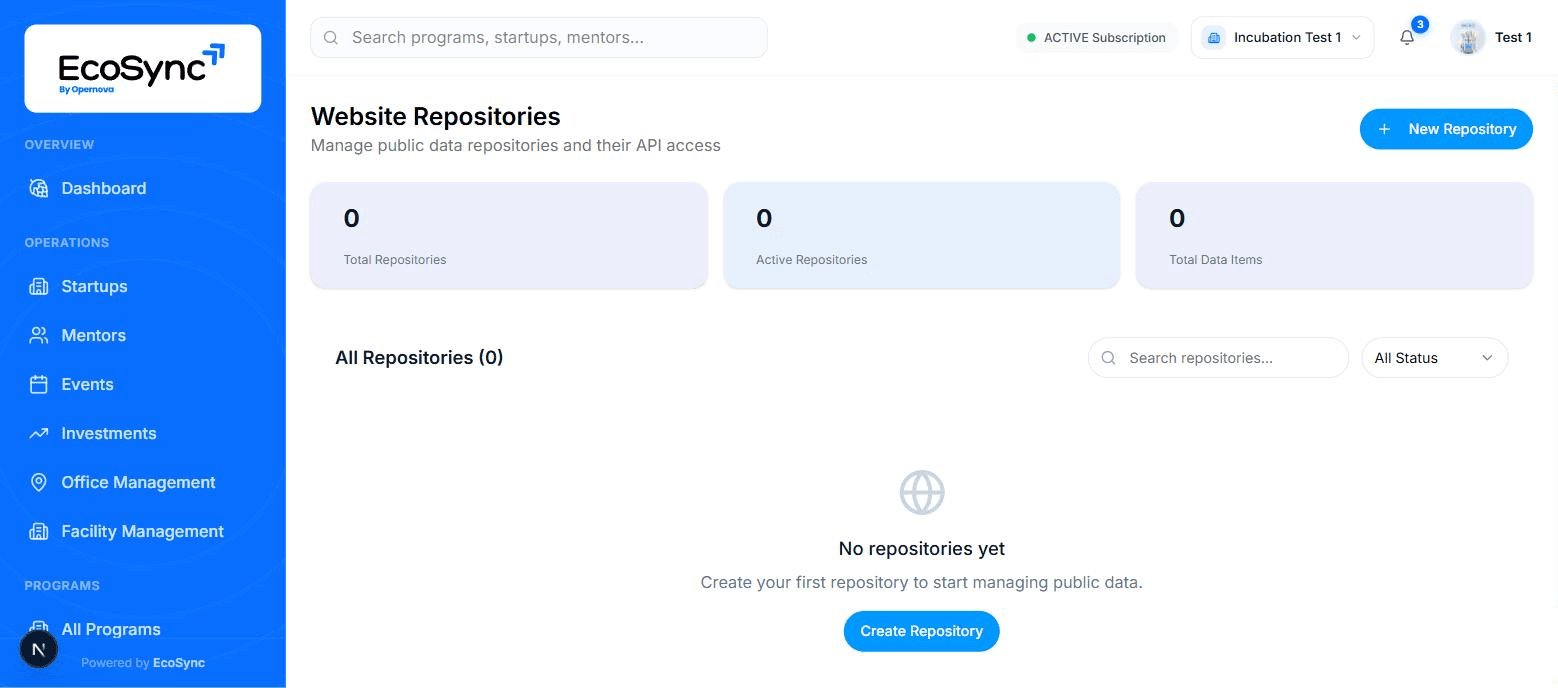
Scheme delivery usually carries an obligation to publish - a portfolio page on your own website, a periodic return to the sanctioning department, or a feed into a funder's dashboard.
A public data API lets you expose selected data with issued keys, rate limiting and access logging, so the published view is generated from the same records you administer rather than maintained separately and drifting out of date. Dashboards cover applications over time, startups by stage, occupancy and revenue for internal and board reporting.
Multiple schemes, one portal
Government-affiliated incubators frequently deliver several schemes at once, each with its own sanctioned amount, eligibility criteria, evaluation rubric and reporting cycle.
Each scheme is a program with its own funding source, application form, rubric and batches. Officers can be assigned to specific programs, so a person administering one scheme is not automatically administering all of them. Reporting can be produced per scheme, per program or per startup without separating the data by hand.
Questions people actually ask
Can we trace a specific disbursement back to a scheme?
Yes - that is the core design. Every tranche disbursed to a startup traces back through its program allocation to the funding source it was sanctioned from. Over-allocating a source is blocked at entry, and each action is logged with the person and timestamp.
Can we run more than one scheme in the same portal?
Yes. Each scheme is a program with its own funding source, application form, evaluation rubric and batches. Officers can be assigned to specific programs, and reporting can be produced per scheme without manually separating data.
How do we handle empanelled external evaluators?
Add them as panel members assigned to specific programs. They can evaluate applications in those programs without being granted a full portal role or access to funding records.
Is there an audit trail suitable for a government audit?
Applications, tasks, funding actions, announcements and permission denials are all logged with the acting user and timestamp, and evaluation records retain per-evaluator scores. Whether that satisfies a particular audit standard depends on the standard - bring us your requirement and we will map it against what is recorded rather than guess.
Can we publish portfolio data to a funder's dashboard?
Yes. A public data API lets you expose selected data with issued keys, rate limiting and access logging, so a published view stays consistent with your live records instead of being maintained separately.
How is access restricted between officers?
A five-level permission model - create, read, update, delete, full - applied per module, with per-user overrides. Denied attempts are logged, which is what demonstrates enforcement rather than mere configuration.
Where is our data, and who can see it?
Your portal's data is isolated from every other incubator on the platform, and encrypted in transit and at rest. Within your portal, visibility is governed by the role and permission model you define.
Related
- Incubation management software
- For incubators in India
- Funding management
- Documentation: public data repository
Guides on this topic
- Delivering a Government Incubation Scheme
What changes when the money is public: the audit trail, the approval chain, and the reporting that decides whether the scheme is renewed.
- Funding and Schemes for Women Entrepreneurs in India
The schemes, credit routes and support programmes available specifically to women-led businesses in India, what each offers, and how to combine them with general startup schemes.
- State Startup Policies in India: The Support Founders Overlook
Every Indian state runs its own startup policy with grants, subsidies and reimbursements. Why these are less competitive than central schemes, what they typically cover, and how to find yours.
Bring your scheme guidelines
Send us the scheme guidelines and the return you have to file. We will show you which records the platform keeps against each requirement, and tell you plainly where there is a gap.
Book a walkthroughReady to Join
the Ecosystem?
Book a demo

Explore the platform
EcoSync is a product of Opernova Technologies LLP, which also builds EcoSync Network.
© 2026 Opernova Technologies LLP. All rights reserved.