


Software for university incubation centres
A campus incubation centre answers to a governing body, reports to funders, runs on a small team, and turns over its student cohort every year. EcoSync is built for that shape - defensible selection, traceable grants, and a record that survives staff turnover.
The constraints are different on a campus
A university incubation centre is not a small version of a private accelerator. The pressures are genuinely different.
The team is small and often part-time, with faculty splitting time between the centre and teaching. Decisions have to be justified to a governing body or an academic committee. Funding usually comes from a government scheme or a university corpus with real reporting obligations. And the student cohort turns over annually, which means institutional memory lives in documents or nowhere at all.
That last point is the one most tooling ignores. When the program manager changes and the previous one's spreadsheets are on a laptop that has left, the centre loses its history.
If that history is still in a spreadsheet, it does not have to be retyped. Import the centre's startup list once - schemes become programmes and batches, joining and leaving dates keep the precision the file had, founders are split out of a shared cell - and it is part of the record from then on.
- Small, often part-time teams with faculty involvement
- Decisions reviewed by committees months after the fact
- Scheme and corpus funding with reporting obligations
- Annual student turnover, so memory has to be institutional
- Multiple program types - pre-incubation, incubation, faculty ventures
Selection you can take to a committee
Academic selection processes attract scrutiny precisely because the people involved are known to each other. A defensible process protects the centre and the people running it.
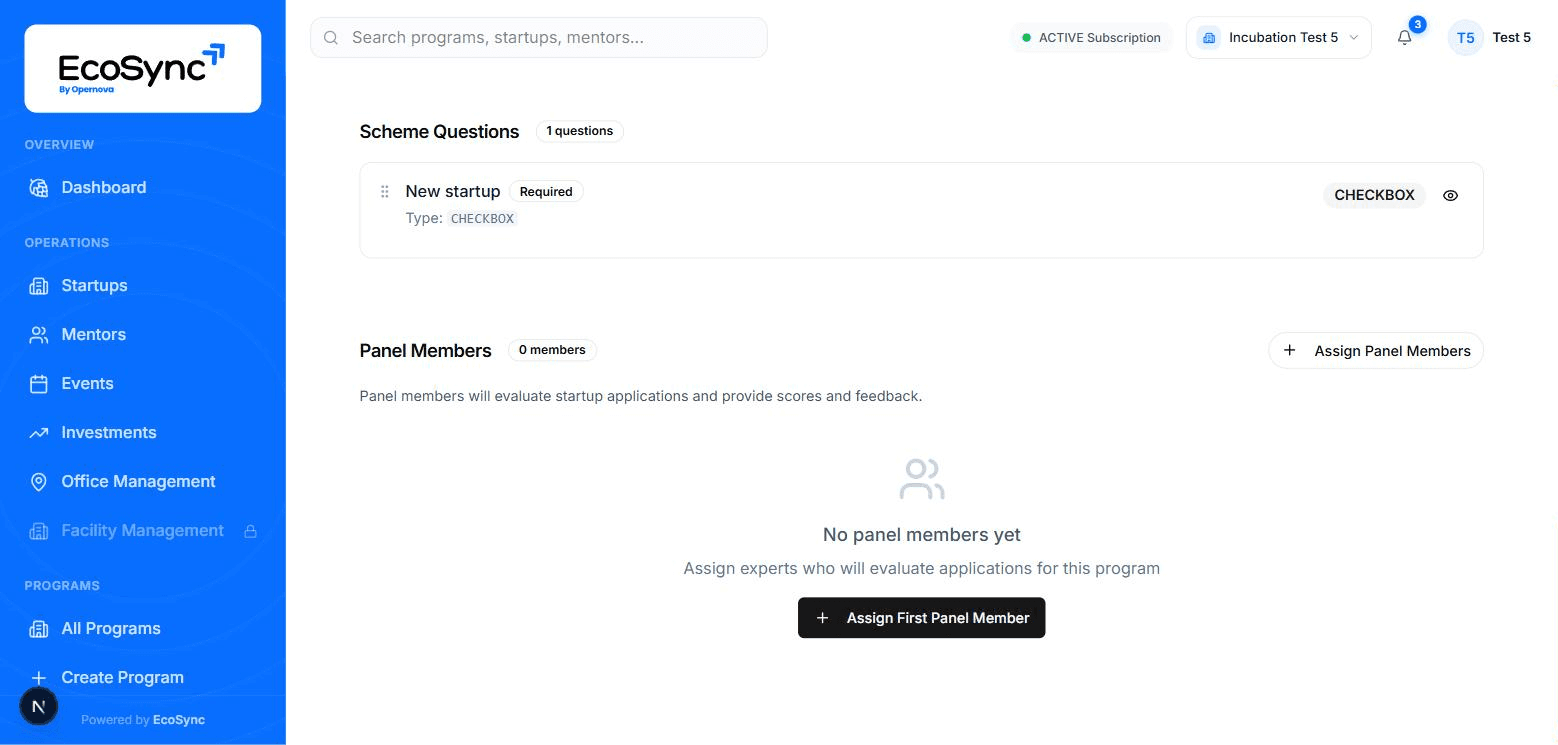
Define a weighted rubric with scored options before applications open. Assign panel members to specific programs - including external experts who get evaluation access without access to the rest of the portal. Each evaluator scores independently, and the system keeps the per-evaluator breakdown rather than presenting a single average that hides disagreement.
Combined with an audit trail on every application status change, the record of how a cohort was selected is intact regardless of who is asked about it later.
Several program types under one roof
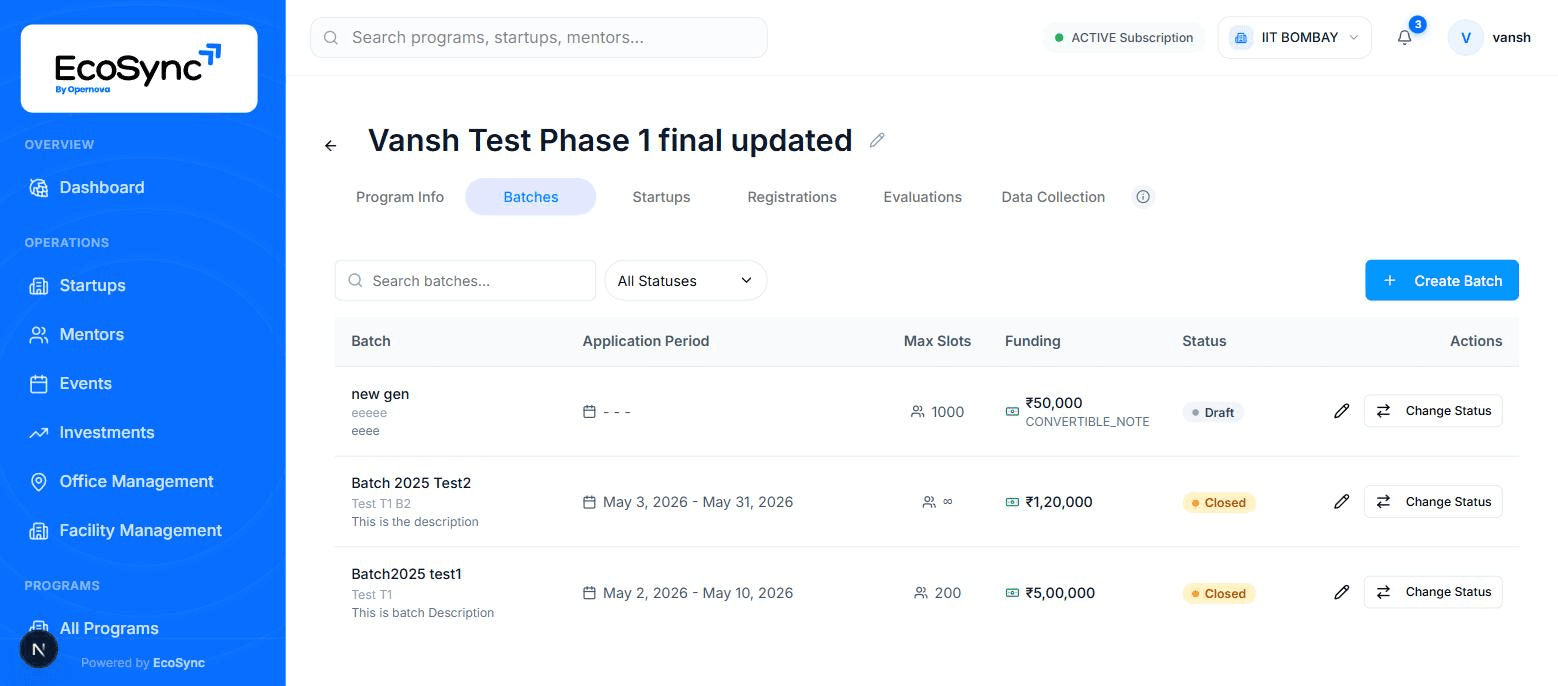
Most campus centres run more than one thing at once: a pre-incubation or ideation track for students, a full incubation program for registered startups, sometimes a faculty venture track or a scheme-specific cohort with its own criteria.
Each of those is a program with its own application form, its own rubric and its own batches. A student ideation track does not have to be squeezed into the same questionnaire as a deep-tech incubation program. Batches inside a program let this year's cohort and last year's run alongside each other without duplicating the program definition.
Student, alumni and faculty founders, counted
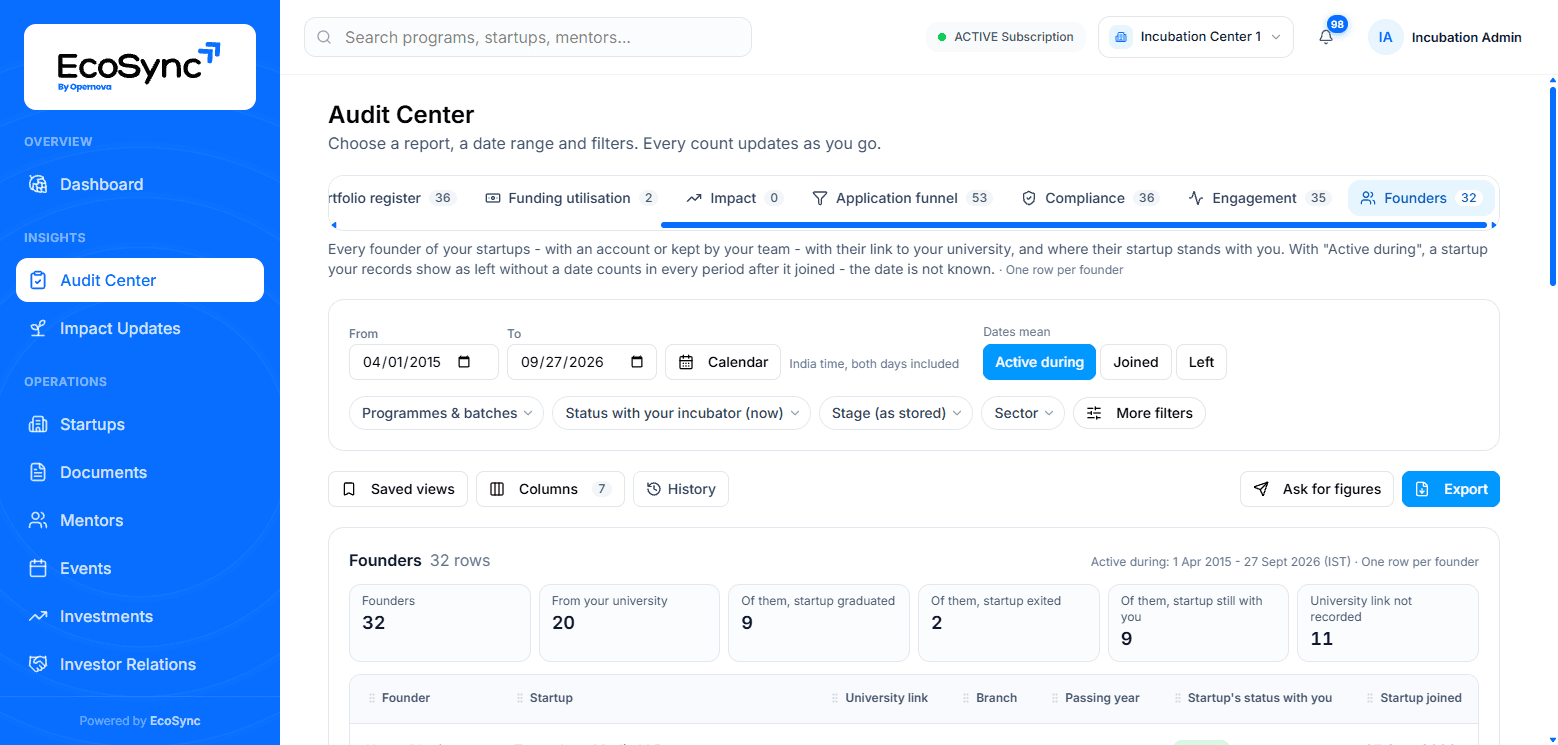
The question a campus centre is asked most is not about startups. It is about people: how many of the founders are our students, our alumni, our faculty - and of their startups, how many graduated and how many exited.
Each founder can carry their link to the university - student, alumnus, faculty, staff or external - with a branch and a passing year, set one at a time or for a whole imported sheet at once. The Founders report counts them by that link, next to where each startup stands with the centre, for whatever period the committee asks about. A founder whose link was never recorded is counted as exactly that, rather than guessed.
- Founders by university link, with branch and passing year
- Of them, startups graduated, exited and still with the centre
- Founders kept by your team count too - no account needed
- Every report and sheet exports to Excel
Grants, corpus funding, and the reporting that follows
Campus centres are frequently funded through a government scheme, a university corpus, or a mix - each with its own expectation about how money is accounted for.
Funding is recorded as a source, allocated to a program, and disbursed to startups in tranches. Allocating more than a source holds is blocked at entry. Every disbursement traces back through its allocation to its source, so a question about a specific payment has a specific answer, and reporting per funder does not require rebuilding the picture from receipts.
Labs, equipment and space
Campus centres usually control physical resources that are genuinely scarce - a fabrication lab, prototyping equipment, meeting rooms, incubatee desks.
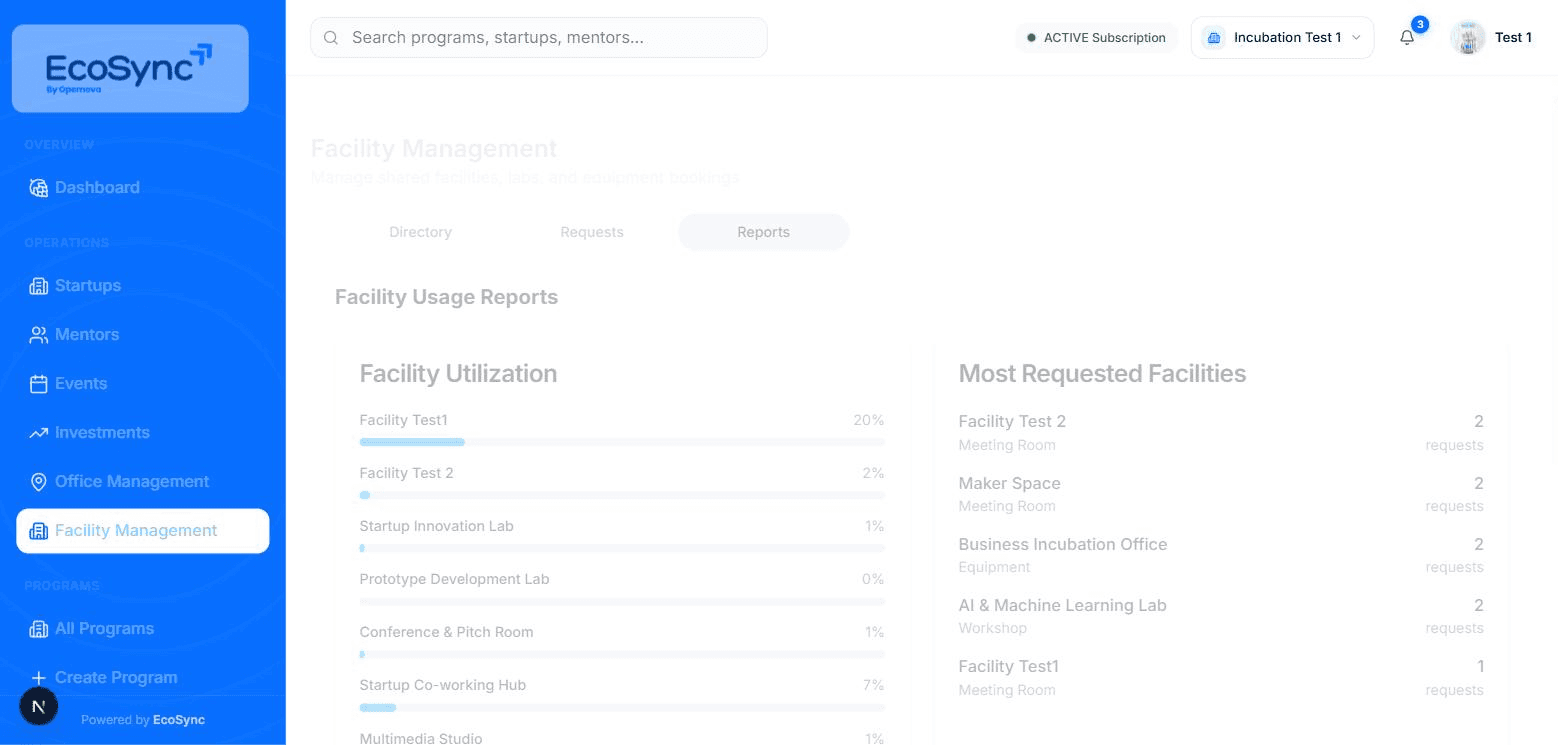
Facilities are bookable against day-of-week time slots with an approval step where supervision is needed, and slots can be blocked out for teaching or maintenance. Utilisation reporting tells you whether the equipment the centre argued for is actually being used, which is a materially better position to be in at the next budget meeting. Desks and cabins can be allocated with terms and, where the university permits it, charged for.
Visibility beyond the campus
A campus centre's biggest structural disadvantage is reach. Its startups are visible to the university and not much further.
Because the portal shares one identity layer with a public ecosystem network, startups in your programs are profiles founders, mentors and investors can actually find. Your programs are discoverable to applicants who never walked past your building. Mentors can be drawn from a public marketplace rather than only the alumni you can reach personally, with arrangements where the centre pays, the startup pays, the cost is subsidised, or the mentor works on a retainer.
Questions people actually ask
Can we run student and non-student programs separately?
Yes. Each program has its own application form, evaluation rubric and batches, so a student ideation track, a full incubation program and a faculty venture track can run concurrently with entirely different criteria.
Can faculty evaluate applications without full portal access?
Yes. Panel members are assigned to specific programs and can be added without a full portal role, so faculty and external experts can score applications in their programs without access to funding records or the rest of the portal.
Will this satisfy our governing body's reporting requirements?
It gives you the underlying record: weighted evaluation scores with per-evaluator breakdowns, an audit trail on every application status change, funding traced from source through allocation to tranche, founders counted by their link to the university, and dashboards covering applications over time, startups by stage and occupancy. Tabs export to Excel in the column order and under the headers you set, which is usually most of the way to a committee's template. Whether that meets a specific committee's format is worth checking with us against your actual reporting template.
What happens when our program manager changes?
The history stays in the system rather than on someone's laptop. Applications, evaluations, funding decisions, tasks and announcements are all recorded with who did what and when, so an incoming manager inherits the record instead of starting over. The years before you joined can come in too: an existing startup list imports with the dates it records, and can be undone within a week if the first attempt was wrong and nobody has worked on it yet.
Can we manage lab and equipment bookings?
Yes. Facilities are bookable against day-of-week time slots, with optional approval, blocked slots for teaching or maintenance, and utilisation reporting per facility.
Is it affordable for a campus centre?
Plans are structured around user limits, startup limits, storage and which modules you need, so a centre using a narrower set of modules is on a correspondingly smaller plan. Pilot runs are available so you can put one cohort through before committing. Current pricing appears in the portal after sign-in - contact us and we will walk you through it.
Related
- Incubation management software
- For incubators in India
- Panel evaluation
- Documentation: incubation portal overview
Guides on this topic
- Setting Up a University Incubation Centre
The decisions that are hard to reverse - governance, IP, who can apply, and whether it sits inside the institution or beside it. Written for year zero.
- Atal Incubation Centres Explained: What AIC Support Involves
What an Atal Incubation Centre is, how it differs from a private accelerator, what founders can expect from one, and how to work out whether applying is worth your time.
- Incubator vs Accelerator: What Is the Actual Difference?
The two terms are used interchangeably and mean different things. Duration, equity, stage, selectivity and what each is genuinely useful for - plus how to choose.
- What Is a Technology Business Incubator (TBI)?
TBIs explained: what they do, how they are funded, how they differ from private incubators, what support they provide, and how a startup gets in.
Bring your governing body's reporting template
The most useful conversation we can have with a campus centre is about the report you have to produce. Show us the template and we will show you where each number comes from.
Book a walkthroughReady to Join
the Ecosystem?
Book a demo

Explore the platform
EcoSync is a product of Opernova Technologies LLP, which also builds EcoSync Network.
© 2026 Opernova Technologies LLP. All rights reserved.